
URL: https://physikseminar.desy.de/hamburg/colloquia_in_2026/31_march_2026/@@siteview
Breadcrumb Navigation
The SuperKEKB/Belle II project: Pioneering the luminosity frontier to explore physics beyond the TeV scale
Kodai Matsuoka (KEK and Nagoya University)
Auditorium (Bldg 5, DESY Hamburg) and Zoom, 16:00h
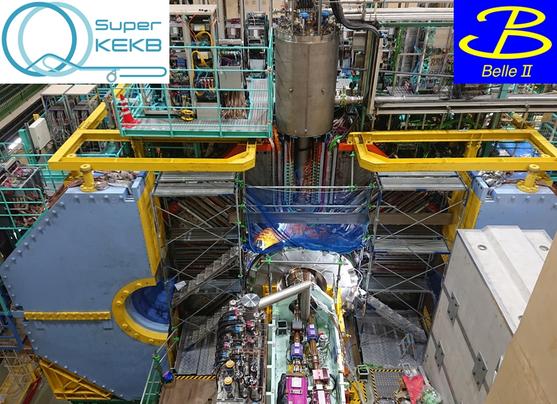
With no consensus on the next guiding principles or leading theories in particle physics, discovering new particles or phenomena is crucial to opening the door to a new era of physics. Precision measurements of heavy quarks and leptons hold the discovery potential for energy scales beyond the TeV range, which cannot be directly reached with current accelerator technology. The Belle II experiment is running at the forefront of this field by exploiting the unique features of its experimental conditions and detector performance, which allow for the efficient detection of both charged and neutral particles in the final state. We are on track to publish world-leading results in a variety of physics, including heavy-flavor quarks and leptons, dark sector, and hadrons. A vast number of events are also essential for these precision measurements. They are provided by the SuperKEKB electron-positron collider, operating at center-of-mass energies at and around 10.58 GeV. SuperKEKB has achieved the world's highest luminosity, owing to the novel "nano-beam" collision scheme, and continues to enhance the luminosity. It has also employed other new technologies, serving as a demonstrator for a future Higgs factory. Although many challenges and unknown phenomena have been identified in the nano-beam collisions affecting both the accelerator and detector, we have made steady progress through simulations, beam studies, tuning and innovative ideas. Further improvements are expected with major upgrades of the accelerator and detector planned for the long shutdown starting in 2032, which will extend the Belle II physics reach. I will share the excitement of this project and the anticipation of new discoveries.
We invite you to attend the presentations in person at the DESY Auditorium in building 5. We will also offer a webcast for this colloquium.
Connection details:
Zoom link: https://desy.zoom.us/j/99616528733
Meeting ID: 996 1652 8733
Meeting Password: 733220

